









By Prof. Kariuki Muigua SC, OGW, Ph.D, FCS, FCIArb, Ch.Arb, Managing Partner, Kariuki Muigua & Co. Advocates & Member, Permanent Court of Arbitration (PCA).
1.0 Introduction: The Imperative for Just Carbon Markets in Africa
This paper establishes that carbon markets are a vital tool for financing climate action in Africa. However, it argues that their design and implementation often fail to address fundamental issues of fairness, equity, and human rights. The paper posits that without a deliberate focus on justice, carbon projects risk replicating historical patterns of exploitation, harming the vulnerable communities they are meant to benefit. It introduces carbon justice as the essential framework to ensure these markets contribute to true community harmony and sustainable development.
2.0 Carbon Justice Concerns in Africa: The Gap Between Promise and Reality
The analysis details the significant injustices arising from poorly governed carbon markets on the continent.
- The Violation of Community Rights and Land Tenure:
- A core injustice is the implementation of carbon projects on lands and territories of indigenous peoples and local communities without their Free, Prior, and Informed Consent (FPIC). This leads to displacement, loss of livelihoods, and cultural erosion.
- Root Cause: Weak land tenure systems and the pursuit of large-scale land acquisition for carbon credits incentivize these violations, treating communities as obstacles rather than rights-holders.
- Governance Failures and Inequitable Outcomes:
- Carbon markets in Africa suffer from severe transparency deficits, corruption, and mismanagement. This results in the misappropriation of carbon revenue, undermining equitable benefit-sharing with local communities.
- Consequence: The financial benefits of climate finance are captured by external investors and intermediaries, while local populations bear the social and environmental costs, fueling conflict and distrust.
3.0 Applying Carbon Justice: A Framework for Ethical Climate Action
The paper proposes a concrete framework built on the tenets of carbon justice to realign the sector with ethical and effective practice.
- Defining the Principle:
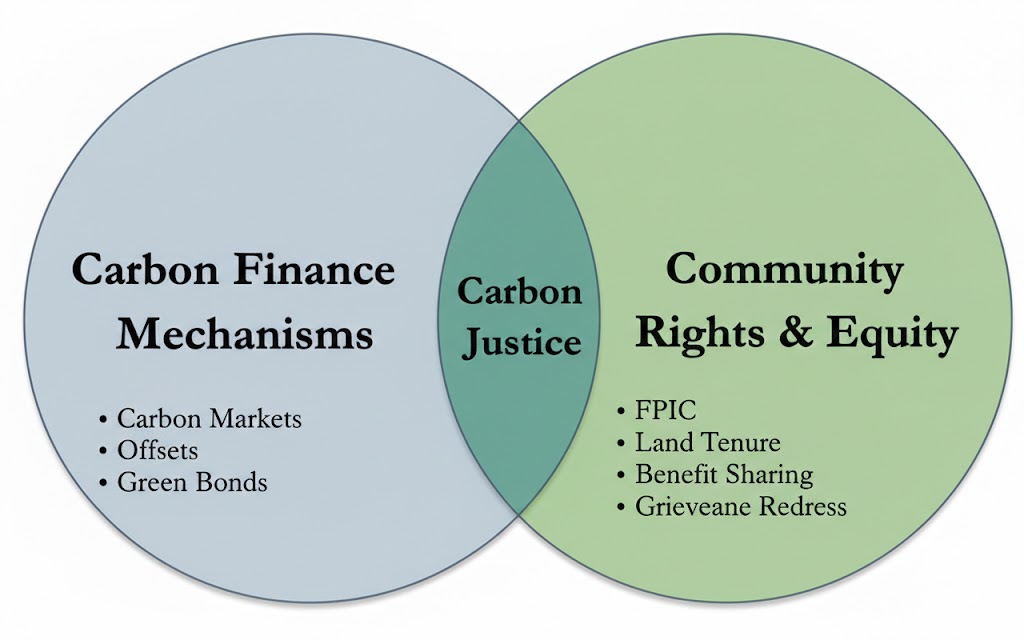
- Carbon Justice is defined as a concept that ensures fairness and equity in climate action by upholding the rights of vulnerable groups in carbon markets. It mandates that projects must protect communities and the environment where they operate.
- Pillar 1: Upholding Foundational Community Rights
- Core Action: Guarantee the right to Free, Prior, and Informed Consent (FPIC) and secure the land and tenure rights of indigenous peoples and local communities as a non-negotiable prerequisite for any project.
- Impact: This shifts communities from passive subjects to essential partners, ensuring their meaningful participation and protecting them from displacement.
- Pillar 2: Ensuring Transparency and Equitable Benefit-Sharing
- Core Action: Mandate radical transparency in carbon credit deals, pricing, and revenue flows. Establish and enforce legal frameworks for equitable benefit-sharing that guarantee local communities receive fair monetary and non-monetary rewards.
- Pillar 3: Guaranteeing Access to Justice and Accountability
- Core Action: Establish accessible grievance mechanisms and legal pathways for communities to seek redress for harms caused by carbon projects.
4.0 Conclusion: Carbon Justice as a Prerequisite for Sustainable Development
The paper concludes that for carbon markets to fulfill their promise in Africa, justice cannot be an afterthought. Carbon justice is the indispensable operational foundation for ethical and effective climate finance. By systematically applying its tenets—centering community rights, ensuring transparency, and guaranteeing equity—carbon markets can transform from a potential source of conflict into a powerful engine for community harmony, resilience, and sustainable development, ensuring the green transition leaves no one behind.