








The Book Author: Prof. Kariuki Muigua SC
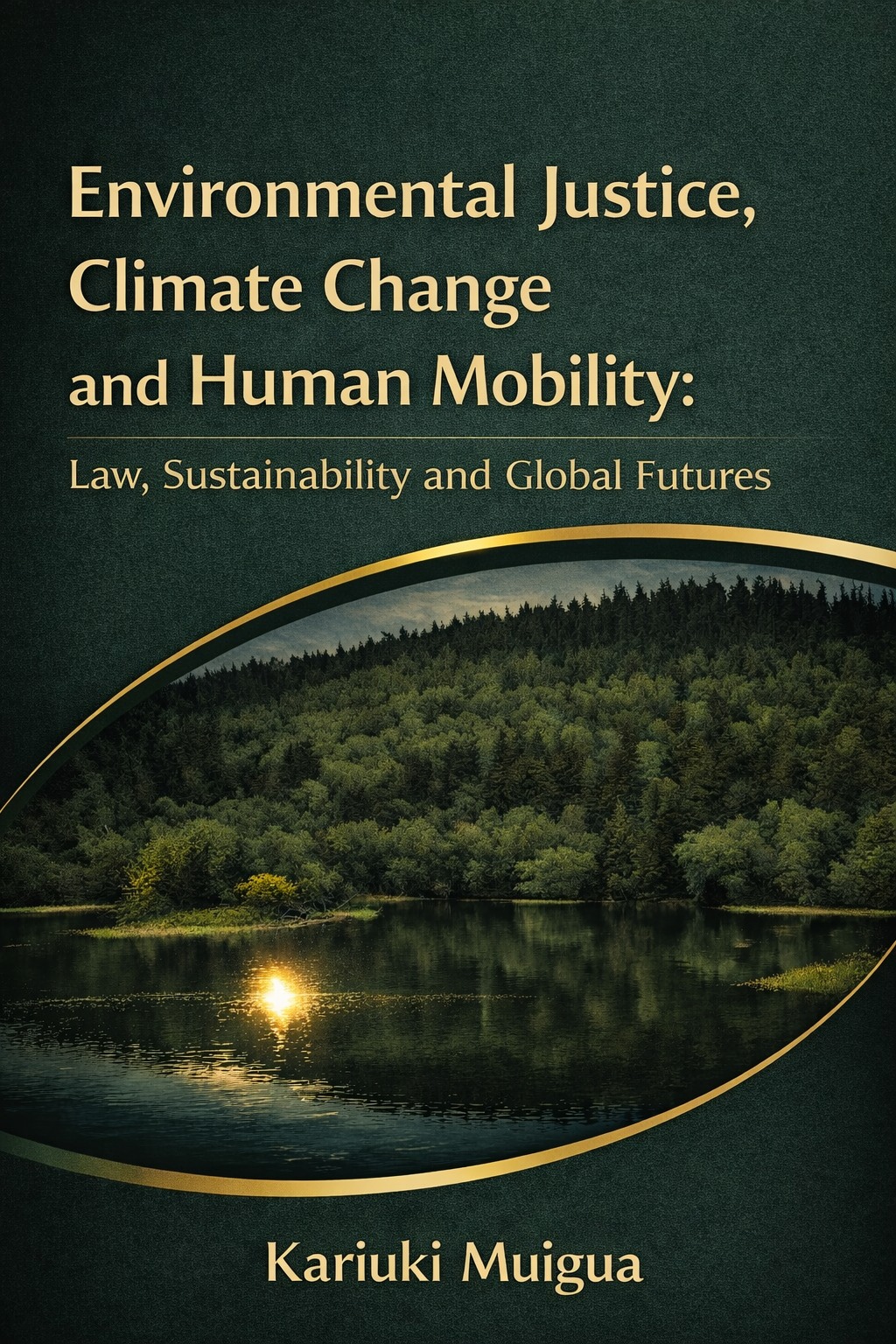
Environmental Justice, Climate Change and Human Mobility: Law, Sustainability and Global Futures is an incisive and urgent volume is authored by Hon. Prof. Kariuki Muigua, Ph.D., SC, C.Arb, OGW—a preeminent Kenyan legal scholar, Senior Counsel, and distinguished authority in environmental law and sustainable development. His profound expertise, cultivated through decades of academic rigor and practical engagement in environmental governance and dispute resolution, permeates every chapter of the book. The work embodies his deep-seated conviction that climate change and its attendant human displacements are not merely ecological or logistical challenges, but profound crises of justice, demanding a reconceptualization of legal frameworks, governance structures, and ethical imperatives on a global scale. His analysis is rooted in the understanding that law must evolve from a reactive, sectoral tool into an integrative, forward-looking instrument for equity, protection, and resilience.
The Book Subject: A Nexus of Crisis and Justice
The book’s central subject is the critical nexus between environmental justice, climate change, and human mobility, examined through the transformative lenses of law, sustainability, and global futures. It moves decisively beyond treating these as isolated phenomena, instead framing them as interconnected strands of a single, complex emergency. Climate change is positioned not just as an environmental process, but as a potent driver of injustice—disproportionately impacting the world’s most vulnerable—and as a primary catalyst for displacement, migration, and planned relocation. The work rigorously interrogates how legal systems, historically designed for static populations and slower-onset environmental harms, must be reimagined to address the dynamic, existential threats of a rapidly destabilizing climate. It balances the stark reality of ecological disruption with the imperative to uphold human rights, ensure equitable access to resources and justice, and construct sustainable, resilient futures for present and future generations.
The Book Structure and Thematic Exploration
The book is structured into four cohesive sections, comprising 12 detailed chapters, that collectively build a comprehensive and multi-layered argument.
Section I: Environmental Justice, Climate Governance and Sustainability lays the indispensable normative and conceptual groundwork. It establishes environmental justice and the rule of law as the foundational pillars for effective climate governance. Key chapters dissect the links between climate change, environmental injustice, and human mobility, arguing that climate justice is a non-negotiable subset of the broader environmental justice agenda. The section provides a deep analysis of the “environmental rule of law,” defining it not as the mere existence of statutes but as a framework where laws are widely understood, respected, and enforced for equitable and sustainable outcomes. A pivotal chapter explores the implementation of a circular economy as a practical model for sustainability, demonstrating how shifting from linear consumption can mitigate pollution, resource depletion, and greenhouse gas emissions, thereby indirectly alleviating pressures that drive both injustice and displacement.
Section II: Environmental Security, Vulnerability and Human Mobility pivots to the human consequences of environmental breakdown. It explores the intersections between environmental security, systemic vulnerability, and mobility in the age of climate disruption. Using Africa as a poignant case study, the book details how climate change acts as a “threat multiplier,” exacerbating resource scarcity, degrading livelihoods, and fueling human mobility through displacement, migration, and relocation. This mobility is framed not as an isolated event but as a major environmental security concern with grave implications for peace, stability, and human rights. Chapters here critically examine the limits of existing legal protection regimes, such as refugee law, which often fails to recognize climate-induced movement, thereby creating dangerous protection gaps for millions of “climate refugees.” The section argues for a paradigm shift in legal and policy thinking to address these vulnerabilities proactively.
Section III: Accountability, Remedies and Environmental Harm focuses on the crucial mechanisms of legal responsibility and redress. It examines how the law can hold actors accountable for environmental damage and provide remedies for affected communities. A standout chapter makes a compelling case for protecting the environment through criminal law, introducing and championing the concept of “ecocide” as a potential fifth international crime. This radical proposal underscores the severity of widespread, long-term environmental destruction caused by corporate activities, armed conflict, and other human actions. Another detailed chapter focuses on enforcing the right to a clean and healthy environment in Kenya through the robust application of the “polluter pays” principle. It argues that effective enforcement requires moving beyond state-centric action to hold polluters directly and financially liable, thereby internalizing environmental costs, funding restoration, and serving as a powerful deterrent.
Section IV: Protection Gaps, Human Mobility and Global Futures synthesizes the book’s themes to confront the most pressing governance challenges. It directly addresses the inadequacies of current international frameworks in managing climate-induced mobility. The section analyzes the stark limitations of the 1951 Refugee Convention, which offers no protection to those fleeing environmental degradation or slow-onset climate disasters. The book calls for innovative legal and policy reforms, whether through revising existing instruments or creating new, bespoke frameworks for “climate migrants.” This final section ties the quest for environmental and climate justice directly to the global future, arguing that securing safe, resilient, and sustainable habitats—from cities to rural settlements—is paramount. It emphasizes that achieving this requires harnessing diverse tools, including Indigenous knowledge for climate adaptation and fostering green growth in human settlements, to build a just and livable world for all.
Conclusion
Prof. Kariuki Muigua’s Environmental Justice, Climate Change and Human Mobility is a formidable, scholarly, and morally urgent intervention. Its great strength lies in its integrative and interdisciplinary approach, seamlessly weaving together environmental law, human rights, refugee studies, climate science, and sustainability ethics into a coherent and compelling narrative. The book is unflinching in its diagnosis of systemic failures and inequalities but equally committed to proposing concrete, actionable pathways for legal and institutional reform. Its distinctive focus on Africa provides essential context and highlights both the acute vulnerabilities and the resilient agency found within the continent. The emphasis on justice—as the core principle linking environmental protection, climate action, and human mobility—elevates the entire discourse, reminding us that technical solutions are insufficient without equity.
This volume is an essential resource for a wide audience: scholars and students of environmental law, climate policy, and international migration; policymakers and diplomats grappling with the legal dimensions of climate displacement; judges and legal practitioners involved in environmental and human rights litigation; and advocates and NGO workers committed to climate justice and migrant rights. In an era defined by intersecting planetary and humanitarian crises, this book provides the rigorous legal analysis, ethical clarity, and forward-looking vision necessary to navigate toward a more just, sustainable, and humane global future. It stands as a testament to the critical role of law, reimagined with courage and compassion, in shaping that future.